Free GEO and AEO course, with a certificate
Learn how ChatGPT, Gemini, Perplexity and Google's AI features find, read and recommend businesses, and what to change on your own website. 13 tracks, 65 short lessons with their sources, a final exam and a PDF certificate you can add to LinkedIn. Free for everyone: no account, no email, nothing to pay.
- Price
- Free for everyone, now and later
- Length
- 65 lessons of about 2 minutes, in 13 tracks
- Exam
- 30 questions, 80% to pass, retake any time
- Certificate
- PDF with ID, badge, one-click LinkedIn
- Languages
- English, French, Arabic
- Account
- None: progress stays in your browser
- Sources
- 70 dated sources, checked November 9, 2026
What you will learn
Thirteen tracks, from how AI assistants choose their sources to what the EU's rules say. Each lesson is three short cards, one task for your own site and one question.
How AI finds you
Memory, live search, and why every answer is different.
Open the door
robots.txt, AI bots, CDNs and Google's controls.
Be readable
Text, JavaScript, sitemaps, llms.txt and languages.
Be recognised
One name everywhere, schema, Wikidata.
Write to be quoted
First-hand content, answers first, real evidence.
Reputation beyond your site
Where AI looks, reviews, press, communities.
Social channels
Which platforms AI can read, and how to set up yours.
Local and sector playbooks
Museums, universities, NGOs, awards, town halls.
AI agents
Assistants that book, buy and fill in forms.
Measure
Free reports, referrals, your question sheet, logs.
Myths and your monthly routine
Spot false promises and run your own plan.
Law and ethics (EU)
Training opt-outs, AI Act, privacy, accessibility, honesty.
New in November 2026
Second research pass: what changed, and what we corrected.
Every lesson says how sure we are
AI search changes every month and much of what is written about it is guesswork. So each lesson carries a label and its dated sources, and lessons are corrected when a source changes.
- Documented said by the platform itself, a law or a court (49 / 65)
- Evidence-based backed by a credible study, with its limits (8 / 65)
- Open debate not clearly proven: both sides are shown (8 / 65)
Myth or fact? Test yourself
Fifteen things people say about AI search. Pick an answer to see the evidence.
Blocking GPTBot removes you from ChatGPT search.
Why
Myth. GPTBot is for training. ChatGPT search depends on OAI-SearchBot.
Blocking Google-Extended removes you from AI Overviews.
Why
Myth. AI Overviews depend on Googlebot and snippet rules, not Google-Extended.
Google Search ignores llms.txt.
Why
Fact. Google: such files neither harm nor help visibility in Google Search.
FAQ schema still gives you dropdowns in Google.
Why
Myth. FAQ rich results stopped appearing on 7 May 2026.
A tool can tell you your exact ranking position in ChatGPT.
Why
Myth. Answers change nearly every run; only appearance rates are meaningful.
Copilot cites sources from Bing.
Why
Fact. Bing's AI Performance report covers Copilot citations.
Keyword stuffing helps AI quote you.
Why
Myth. In the GEO study it performed worse than doing nothing.
Public Instagram posts of professional accounts can appear in Google.
Why
Fact. Since 10 July 2025, for public professional accounts of adults.
Buying reviews is legal if they look real.
Why
Myth. Banned by the FTC rule (2024) and the EU Omnibus Directive (2022).
Search Console shows AI impressions since 2026.
Why
Fact. Generative AI reports launched in June 2026, worldwide since 31 August 2026.
robots.txt is a technical lock that stops every bot.
Why
Myth. It is a voluntary standard; some user-triggered fetchers may not follow it.
Your CDN can block AI bots even if robots.txt allows them.
Why
Fact. Google lists checking CDN and hosting settings as a best practice.
Cloudflare's “Block AI bots” setting can also block Googlebot.
Why
Fact. Since 15 September 2026 it applies to mixed-use crawlers, including Googlebot, Bingbot and Applebot.
In the US, robots.txt counts as an access control under the DMCA.
Why
Myth. OpenAI copyright litigation (S.D.N.Y., Dec 2025): disregarding robots.txt is not circumvention.
Saudi Arabia allows copying lawfully published works to develop AI.
Why
Fact. Copyright Law 2026, Art. 26(4), in force since 12 August 2026.
Practise on your own website
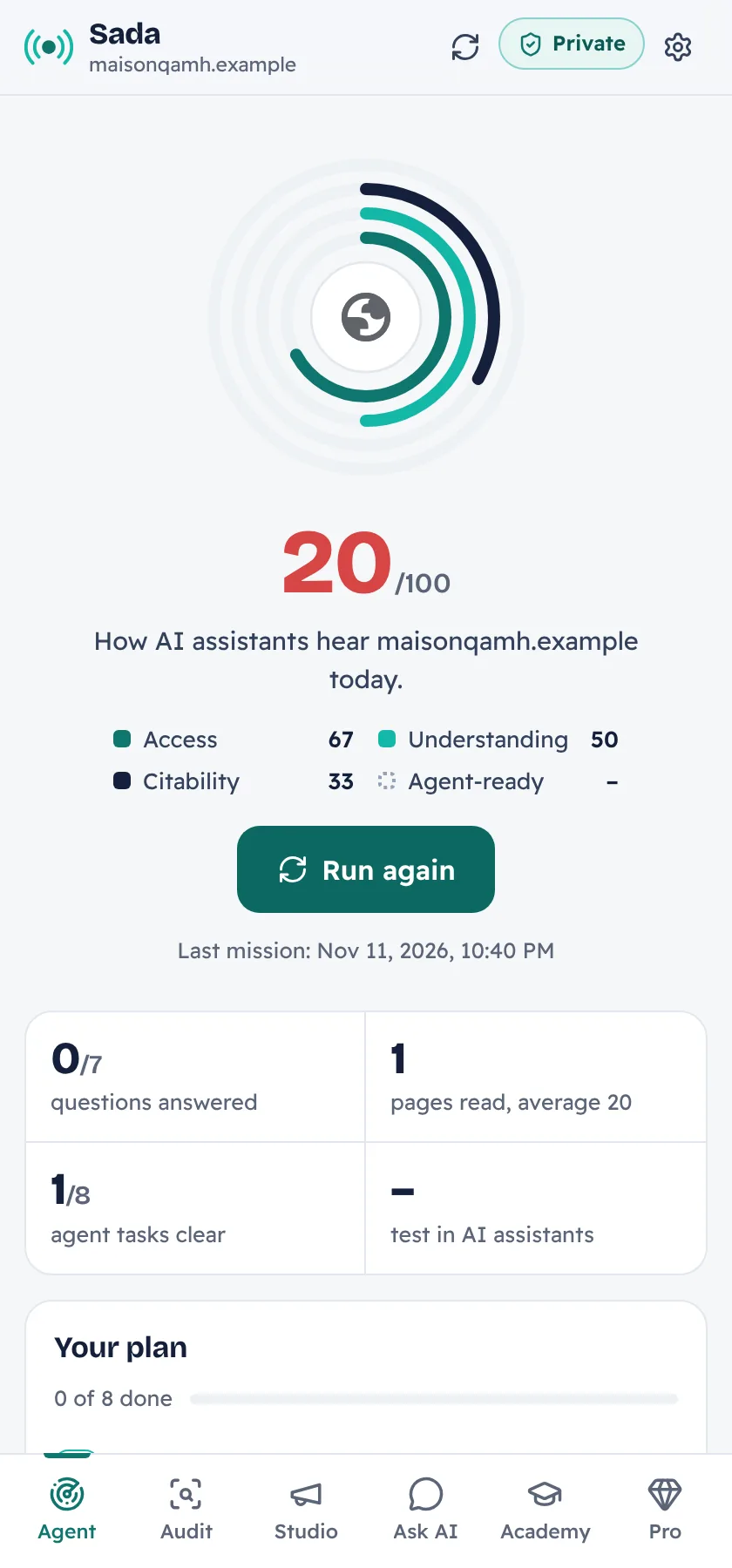
Sada is our free Chrome extension. One click shows how AI assistants read your page, which customer questions it leaves unanswered and what to fix first. The same lessons are built in, next to your own results.
Training for your team
The course is free for everyone. For companies, agencies, universities and public bodies we also run live workshops built around your own website and channels:
- a review of how AI assistants describe your organisation today
- hands-on fixes with your web and content team
- online or on site, in English, French or Arabic
- a written plan your team keeps
Questions
Is the course really free?
Yes, for everyone: the lessons, the exam, the PDF certificate and the LinkedIn badge. There is no account, no email address to give and nothing to pay, now or later.
What is the difference between GEO, AEO and SEO?
SEO is about being found and ranked in search results. AEO (answer engine optimisation) is about being the answer that AI assistants and answer boxes give. GEO (generative engine optimisation) is about being read, trusted, quoted and recommended by generative AI such as ChatGPT, Gemini, Perplexity, Claude and Google's AI Overviews. Most of the work overlaps; this course covers all three where they meet AI answers.
How long does it take?
About two hours for the 65 lessons (about 2 minutes each) and 15 to 20 minutes for the exam. Go at your own pace: your progress is kept in your browser.
How does the exam work?
30 questions drawn from all 13 tracks and the myth-or-fact set; 24 right answers (80%) pass. Every attempt draws new questions and you can retake it as often as you like.
What do I get when I pass?
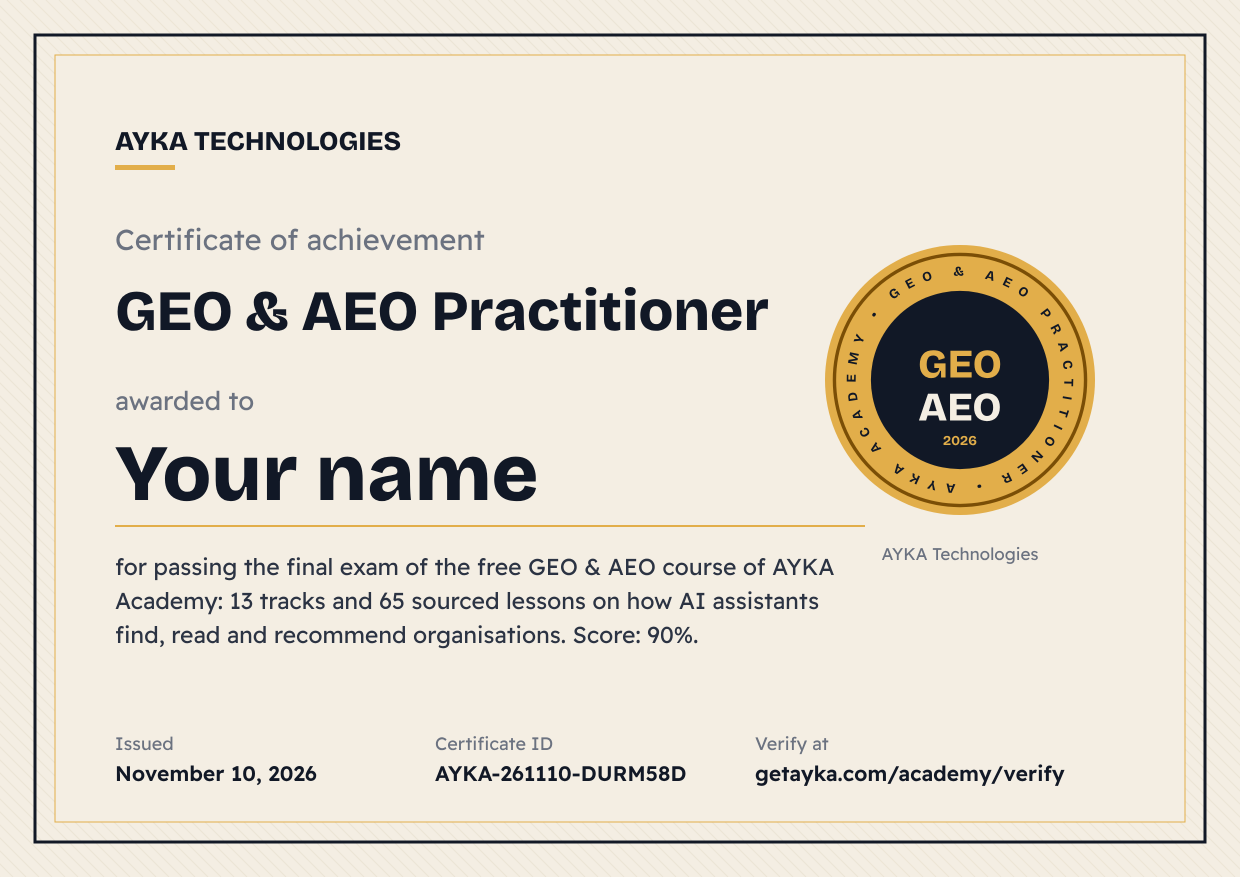
A PDF certificate “GEO & AEO Practitioner” with your name, score, date and certificate ID, a badge image, a link that adds the certificate to your LinkedIn profile in one click, and a verification page for it.
Is the certificate accredited?
No. It is issued by AYKA Technologies and shows that you passed this exam. It is not a university degree or a state-recognised qualification.
Who is it for?
Business owners, marketers, students, web designers, museums, NGOs, town halls: anyone who wants AI assistants to describe their organisation correctly. No technical background is needed; the technical lessons say what to ask your web person.
Where do the facts come from?
Each lesson lists its dated sources: documentation from OpenAI, Google, Anthropic, Microsoft and Cloudflare, laws and court decisions, and published studies. Each lesson is labelled Documented, Evidence-based or Open debate.
In which languages is it available?
English, French and Arabic: the lessons, the exam and the certificate.
Can AYKA train our team?
Yes. We run live workshops for companies, agencies, universities and public bodies, online or on site, in English, French or Arabic, built around your own website. Email hello@getayka.com or book a free 30-minute call.
Can I use the course with my students?
Yes, link to it freely. Teachers and student associations can also write to hello@getayka.com about a guest session.